
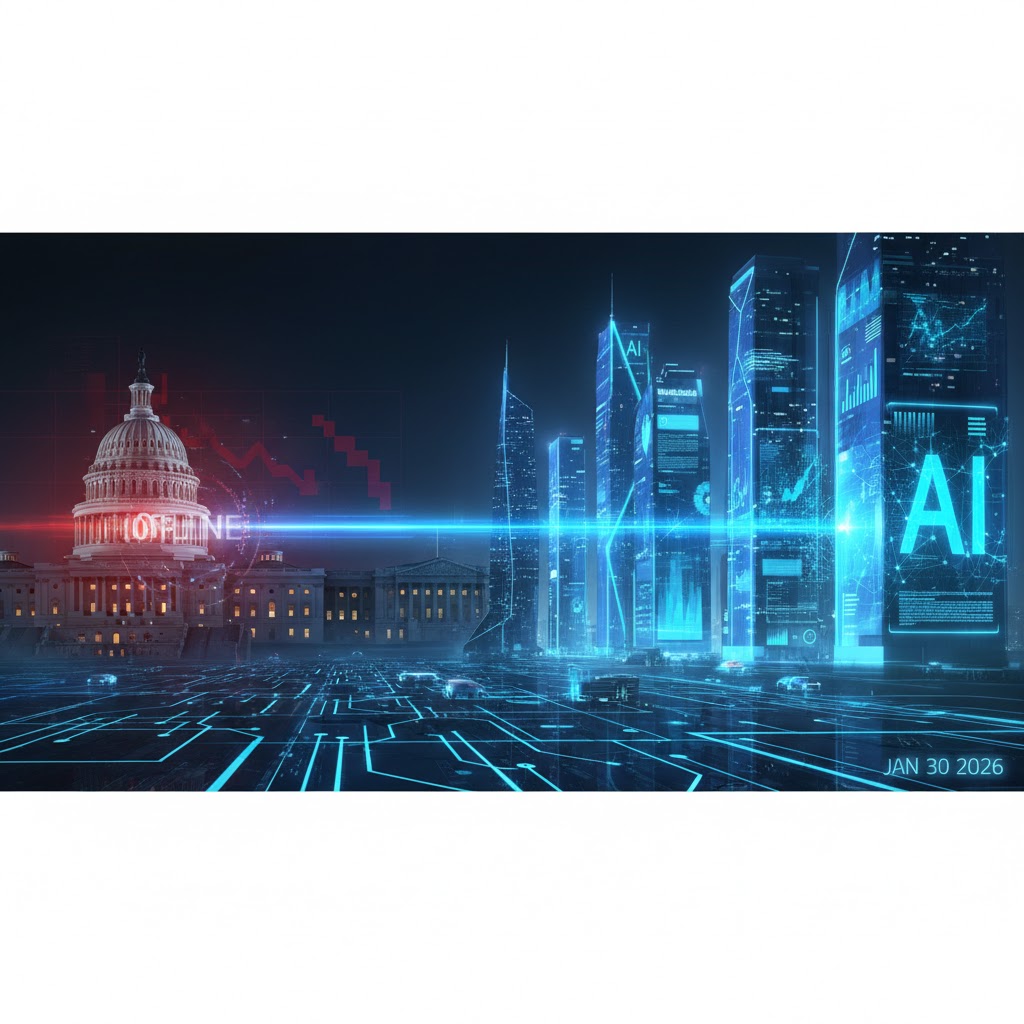
In the ever-shifting landscape of global finance, few events command as much media attention as a United States federal government shutdown. On the surface, the closure of non-essential government agencies, the furloughing of hundreds of thousands of workers, and the cessation of critical data reporting appear to be the precursors to an economic tailspin. However, historical data suggests that Wall Street often treats these episodes as political theater rather than structural catastrophes. As we approach January 30, 2026, the stakes have evolved. Unlike previous budget impasses, the current market is underpinned by a high-valuation artificial intelligence (AI) boom. Understanding the intersection of legislative gridlock and technological momentum is essential for navigating this period of uncertainty.
The Mechanics of a Market Under Pressure
A government shutdown occurs when Congress fails to pass the twelve annual appropriations bills or a continuing resolution to fund federal operations. While essential services such as air traffic control, law enforcement, and the military continue to function, “non-essential” agencies are shuttered. For the markets, the immediate impact is often psychological. Uncertainty is the primary driver of volatility; when the world’s largest economy enters a period of administrative limbo, investors naturally brace for impact.
The economic drag is real but typically temporary. According to the Congressional Budget Office (CBO), a shutdown typically shaves roughly 0.1 to 0.2 percentage points off quarterly GDP growth for every week it lasts. This occurs through lost productivity from furloughed workers and a reduction in government spending on goods and services. However, most of this activity is recovered in subsequent quarters as the government reopens and back pay is issued, creating what economists call a “V-shaped” recovery in federal activity.
Retrospective: How Markets Weathered Recent Shutdowns
To understand the potential fallout of a 2026 shutdown, one must look at the precedent set by recent episodes. Historically, the S&P 500 has proven remarkably resilient during these periods, rising in more than half of all shutdown events since 1976.
The 2013 Shutdown (16 Days)
In October 2013, a 16-day shutdown was triggered by disagreements over the Affordable Care Act. Despite the political vitriol, the S&P 500 actually rose 3.1% during the period. Investors largely ignored the headlines, focusing instead on the Federal Reserve’s accommodative monetary policy and solid corporate earnings.
The 2018–2019 Shutdown (35 Days)
The longest shutdown in U.S. history lasted from late December 2018 to January 2019. This event was particularly notable because it occurred during a period of existing market instability. Interestingly, while the market saw a correction of roughly 13% in the days preceding the shutdown—driven by fears of rising interest rates and trade tensions—the S&P 500 gained 10.3% while the government was actually closed. This suggests that the “bad news” is often priced in before the doors actually lock at the Capitol.
The Fall 2025 Precedent
More recently, the shutdown in late 2025 provided a preview of current dynamics. Spanning approximately six weeks, it was one of the more disruptive events in recent memory. Goldman Sachs and JPMorgan noted that while it caused a temporary 1.5 percentage point drop in fourth-quarter GDP growth, the market’s appetite for large-cap tech remained undeterred. The “flight to quality” favored companies with strong balance sheets and clear growth trajectories, specifically those leading the AI revolution.
January 30, 2026: The AI Market at a Crossroads
The looming deadline of January 30, 2026, presents a unique set of challenges. The market in early 2026 is significantly different from those of 2013 or 2018. Today, the S&P 500 and Nasdaq are heavily concentrated in a handful of mega-cap technology firms whose valuations are predicated on the transformative potential of artificial intelligence.
The Data Fog
One of the most significant risks of a shutdown in this environment is the cessation of government data. The Bureau of Labor Statistics (BLS) and the Bureau of Economic Analysis (BEA) pause their releases of CPI (inflation) and employment data during shutdowns. In a “data-dependent” era, where the Federal Reserve and algorithmic trading bots rely on these numbers to make split-second decisions, a lack of transparency can lead to erratic price swings. If the Fed is forced to fly blind during a pivotal moment in its interest rate cycle, the risk of a policy error increases, which could spook AI investors who are sensitive to borrowing costs.
Stalling Innovation and Regulation
Beyond the immediate stock tickers, a 2026 shutdown threatens the administrative momentum behind AI. By early 2026, the U.S. government has become a major player in the AI ecosystem through executive orders, the National Defense Authorization Act (NDAA) for 2026, and the White House’s AI Action Plan. These initiatives include:
- Export Controls: Implementation of semiconductor restrictions that protect U.S. intellectual property.
- Infrastructure Investment: Funding for the National AI Research Resource (NAIRR), which provides compute power to researchers.
- Defense Contracts: A “wartime footing” for military AI integration.
A prolonged shutdown halts the processing of these contracts and delays the implementation of safety frameworks. For AI-heavy firms like NVIDIA, Microsoft, and Alphabet, this doesn’t just mean a delay in revenue; it means a delay in the regulatory clarity that large institutional investors require for long-term commitment.
Sector-Specific Reactions
While the broad market often shrugs off shutdowns, specific sectors experience the impact with greater intensity.
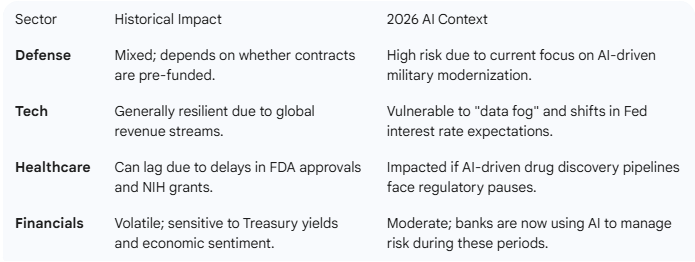
Sector-specific reaction table
Strategies for the 2026 Investor
For the modern investor, the key to surviving a January 30 shutdown is to separate political noise from fundamental value. History shows that the 12 months following a shutdown are almost always positive, with the S&P 500 averaging double-digit gains.
In the AI-driven market of 2026, any pullback sparked by “shutdown anxiety” may represent a buying opportunity rather than a signal to exit. Large-cap AI companies are increasingly viewed as “safe havens” due to their massive cash reserves and global reach, which insulate them from domestic legislative friction. However, a move toward mid-cap or cyclical stocks during a shutdown may be riskier, as these firms often lack the capital buffers to withstand a prolonged dip in consumer confidence or a delay in federal Small Business Administration (SBA) loans.
Conclusion
As the clock ticks toward January 30, the headlines will undoubtedly grow more dire. However, if the past 50 years of market history are any indication, the U.S. financial system is more than capable of handling a few weeks of closed parks and delayed reports. The real story is not the shutdown itself, but how the AI ecosystem continues to decouple from traditional political cycles. While the government may pause, the march of technological progress does not. Investors who remain disciplined, focus on high-conviction tech leaders, and look past the immediate “data fog” will likely find themselves well-positioned when the doors of the Capitol eventually swing open once more.
Works Cited
American Century Investments. “How Do Government Shutdowns Affect Markets?” 1 Oct. 2025.
Brookings Institution. “Government Shutdowns: Causes and Effects.” 2025.
Edward Jones. “Government shutdowns and the markets – 3 things to know.” 28 Oct. 2025.
GovCIO Media & Research. “How AI Developments Could Shake Out After Shutdown.” 13 Oct. 2025.
International Monetary Fund. “World Economic Outlook Update, January 2026.” Jan. 2026.
J.P. Morgan Asset Management. “How does a potential U.S. government shutdown impact markets?” 2025.
Kiplinger. “What Does a Government Shutdown Mean for Stocks?” 1 Oct. 2025.
Lord Abbett. “Investment Brief: Insights into U.S. Government Shutdowns.” 1 Oct. 2025.
Morgan Stanley. “Do Government Shutdowns Matter to Markets?” 1 Oct. 2025.
Nationwide Financial. “Have past government shutdowns sparked market volatility?” 20 Mar. 2025.
Time. “How a Partial Government Shutdown Over ICE Would Impact Immigration Enforcement.” 26 Jan. 2026.
Vanguard. “Staying the course during a government shutdown.” 2025.